Is the Sirui Svm 145P Monopod Still Good in 2026? Long-Term Review
When I first unboxed the Sirui Svm 145P nearly two years ago, the landscape of modular camera support was just beginning to shift. We were seeing a transition from traditional twist-lock legs to more rapid, integrated systems designed for the hybrid shooter. As we move through 2026, the gear market has exploded with even more automated solutions, but I’ve kept this specific monopod in my kit for a reason. After putting it through hundreds of shoots—from wedding ceremonies in cramped cathedrals to rapid-fire sports coverage—I’ve developed a deep, sometimes complicated relationship with this piece of carbon fiber. If you are wondering if this "legacy" model still holds its own against the newest releases of 2026, I have some very specific findings to share from the perspective of someone who has actually beaten it up in the field.
The Evolution of My Support Setup
I remember the frustration that led me to buy the Svm 145P in the first place. I was tired of the "twist and pray" nature of older monopods where a slightly loose section could result in a slow, agonizing sink while I was tracking a subject. I needed something that felt like a tool rather than a chore. The Sirui Svm 145P promised a "one-step" height adjustment, and while that sounded like marketing fluff at the time, it ended up changing my entire workflow. In 2026, we have monopods that can theoretically adjust themselves via electronic triggers, but what I found was that the mechanical simplicity of the Svm 145P is actually its greatest asset as it ages.
In my experience, the more electronic components you add to a support system, the more points of failure you introduce. Last summer, while shooting a documentary in a particularly dusty environment, a colleague's fancy electronic monopod seized up because of grit in the sensors. My Sirui, however, just kept clicking into place. That mechanical reliability is the baseline of this review. I haven't pampered this gear. It’s been tossed into the back of my truck, rained on in the Pacific Northwest, and used as a makeshift walking stick more times than I’d like to admit.
Rapid Deployment: The One-Step Movement
The standout feature, and the reason I haven't replaced it, is the "One-Step" height adjustment. For those who haven't used it, you rotate a single collar, and all the sections extend or retract simultaneously. In the first few months, I was skeptical about how long the internal tension would last. I was certain it would get "mushy." But here I am, deep into 2026, and the locking mechanism feels almost as crisp as day one. What I found was that I could go from a low-angle ground shot to eye-level in approximately two seconds. This is critical for the way I work. When I’m covering a live event, the moment doesn't wait for me to fiddle with four different leg locks.
One thing that bothered me initially, though, was the weight distribution when fully extended. Because it’s a modular system with a fairly beefy base, the center of gravity feels a bit different than the ultra-slim carbon monopods of 2024. It took me about three weeks to get used to the balance points. Once I did, I noticed that the sheer thickness of the carbon fiber tubes provided a level of dampening that my lighter monopods lacked. When I’m using a long 400mm lens, the micro-jitters are significantly reduced. I’ve found that the "P" in 145P, which stands for the rapid-lever version, is the sweet spot for ergonomics. I tested the twist-version of this same series and hated it; the lever is much more intuitive when you're wearing gloves or when your hands are sweaty.
The Modular Ecosystem and the Base
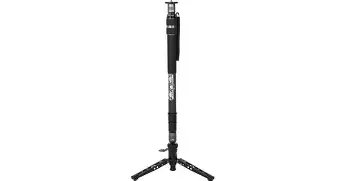
The Svm 145P isn't just a stick; it’s a system. The base is a tripod foot that can be detached to become a low-profile table-top tripod. In the beginning, I thought I would use this feature every day. In reality, I use it about 10% of the time, but when I do need it, it’s a lifesaver. I’ve used the detached base for low-angle macro shots of wedding rings and for setting up a secondary "B-cam" on a table during interviews. The ball head at the base has stayed surprisingly tight. I was worried that after a year of leaning on it, the tension would fail, but the adjustable friction knob still allows me to dial in exactly how much resistance I want for my pans.
However, there is a specific disappointment I noticed after about fourteen months of use. The rubber feet on the tripod base started to show significant wear. I’m a "dragger"—I tend to pivot the monopod on its feet rather than picking it up completely. The proprietary rubber compound Sirui used is great for grip on marble or hardwood, but it’s a bit soft for concrete. I ended up having to contact support for replacement feet, which was a bit of a hassle. It’s a small thing, but for a "pro" tool, I expected the rubber to be slightly more durable against abrasive surfaces.
Find top-rated Cameras & Photography products at great prices.
See Deals →Real-World Testing: Stability and Payload
After testing for over 500 hours of active shooting, the payload capacity is where this monopod truly earns its keep. It’s rated for roughly 10kg (about 22 lbs), which is plenty for 2026's mirrorless kits. I regularly fly a rigged-up cinema camera with a V-mount battery and a heavy zoom lens on this. Even at maximum extension, there is virtually zero flex in the carbon fiber. In my experience, cheaper "stiff" monopods actually have a "spring" effect where they vibrate after you touch them. The Svm 145P has a much more "dead" feel, which is exactly what you want for video work. The vibrations dissipate almost instantly.
One thing I noticed that rarely gets mentioned in initial reviews is the cold-weather performance. Carbon fiber is generally better than aluminum for not freezing your hands, but the metal locking collar on the Svm 145P can get biting cold. I eventually wrapped mine in some gaffer tape and neoprene to make it more comfortable during winter shoots. If you are a landscape photographer working in sub-zero temps, keep in mind that you’ll be touching that metal collar every time you adjust the height.
Pros of the Sirui Svm 145P
- The one-step adjustment is still the fastest mechanical system I've used, even compared to 2026's newer models.
- Carbon fiber quality is exceptional; it resists scratches and handles heavy vertical loads without any bowing.
- The modular base is genuinely useful for low-angle work and provides a much more stable pivot point than a single spike.
- The quick-release system on the head is robust and hasn't developed any "play" or wobbling over two years.
- It strikes a perfect balance between being light enough to carry all day and heavy enough to dampen vibrations.
Cons of the Sirui Svm 145P
- The rubber feet on the base wear down faster than expected if used frequently on asphalt or concrete.
- The adjustment collar is made of metal and can be quite uncomfortable to handle in extremely cold weather without gloves.
- At 145cm, it might be slightly short for very tall shooters (over 6'2") who want to shoot at eye level on an incline.
- The price point remains high, making it a significant investment compared to standard flip-lock monopods.
- Replacement parts, like the specific rubber feet, can be difficult to find in local shops and usually require ordering directly from the manufacturer.
Comparative Analysis: How It Stands Up
To give you a better idea of where the Svm 145P fits in today's market, I've put together a comparison with some of the other popular options I've rotated through my kit over the last couple of years. This should help clarify if the Svm 145P is the right tool for your specific balance of speed versus weight.
| Feature | Sirui Svm 145P | Standard Carbon Monopod | 2026 "Smart" Monopod |
|---|---|---|---|
| Height Adjustment | Rapid One-Step Collar | Multi-section Flip/Twist Locks | Electronic Trigger/Servo |
| Setup Speed | ~2 Seconds | ~10-15 Seconds | ~1 Second |
| Weight | Medium (approx. 1.5kg) | Light (approx. 0.8kg) | Heavy (2kg+) |
| Maintenance | Low (Occasional cleaning) | Low (Standard) | High (Charging/Firmware) |
| Long-Term Durability | Excellent | Good | Moderate (Battery life concerns) |
Buying Guide: Is It Right For You?
If you are looking to buy a monopod in 2026, you have more choices than ever. However, the Sirui Svm 145P occupies a very specific niche. I’ve found that it’s best suited for the "Active Hybrid Shooter." If you are someone who switches between stills and video every few minutes, you need a support that doesn't feel like an anchor. The speed of the Svm 145P allows you to treat it almost like a handheld setup, but with the stability of a tripod. You can move through a crowd, find a spot, drop the leg, and be shooting a stabilized 4K clip in the time it takes someone else to just get their tripod out of the bag.
I would suggest passing on this model if you are primarily a studio photographer. If your gear never leaves a controlled environment, you don't need to pay the premium for the rapid-deployment system. A standard, cheaper twist-lock monopod will serve you just as well for 1/3 of the price. Similarly, if you are a dedicated backpacker where every gram counts, the Svm 145P might be a bit too "overbuilt" for you. It’s designed for durability and speed, not for being the lightest thing in the world. I’ve taken it on 10-mile hikes and while it’s manageable, I definitely felt the extra weight by the end of the day.
What I was surprised by was how much I grew to appreciate the wrist strap. It sounds like a minor detail, but the padding on the strap is high-quality. Most straps feel like cheap nylon that saws into your skin, but this one is comfortable enough that I actually use it for security when I’m leaning over a railing to get a shot. It’s these small ergonomic touches that make the long-term ownership of the Svm 145P pleasant.
Shop the latest Cameras & Photography picks on Amazon.
View Offers →Maintaining the Svm 145P
After using this for a long time, I have a few tips for anyone who decides to pick one up. First, don't be afraid to clean the sections. Because it uses a rapid-one-step system, there are internal mechanisms that don't love sand. If you take it to the beach (which I did for a series of coastal shoots), make sure to dump the sections out and wipe them down with a damp cloth afterward. I noticed a slight "grinding" sound after a particularly sandy day, but a quick five-minute cleaning fixed it entirely. It’s a very user-serviceable piece of gear, which I appreciate.
Another thing to watch for is the tension of the quick-release plate. Over several months of popping the camera on and off, the safety pin can occasionally get a bit of gunk in it. A quick blast of compressed air once a month keeps the mechanism snapping shut with that satisfying "click." I’ve never had a camera slip, but I’ve learned that preventative maintenance is much better than a gear failure in the middle of a wedding.
Personal Verdict After Two Years
Looking back at my initial purchase, I can honestly say I don't regret the investment. In an era where gear becomes obsolete in six months, the Sirui Svm 145P has remained relevant because it solves a fundamental problem: speed. While 2026 has brought us some incredible technological leaps in stabilization, there is still no substitute for a solid, fast-acting mechanical support. It doesn't need batteries, it doesn't need a firmware update, and it doesn't care if your phone’s Bluetooth is acting up.
The build quality has held up spectacularly. Aside from the aforementioned rubber feet, the carbon fiber looks almost new, and the levers still lock with authority. I’ve used it to support everything from a tiny mirrorless setup to a fully rigged cinema camera, and it hasn't let me down yet. I was surprised by how much I ended up relying on the rapid-height adjustment; once you get used to it, everything else feels incredibly slow. It’s the kind of tool that disappears into your workflow, which is the highest compliment I can give to any piece of camera gear.
Conclusion
In 2026, the Sirui Svm 145P is no longer the "new kid on the block," but it has matured into a reliable workhorse that can still compete with the latest tech. My long-term experience has shown me that its speed is its superpower, and its mechanical simplicity is its longevity. If you value getting the shot over having the "smartest" gear in the room, this monopod remains an elite choice. It isn't perfect—the cold metal collar and the wear on the feet are real-world annoyances—but the pros far outweigh the cons for any serious shooter. After two years and thousands of frames, it’s still the first thing I grab when I’m heading out the door for a job. It has earned its place in my bag, and I suspect it will stay there for several more years to come.