5 Hidden Features of the Agon Pro Ag276Qzd2 You Must Know About
The Agon Pro Ag276Qzd2 is marketed toward serious gamers and content creators who expect high refresh rates, crisp QHD resolution, and responsive performance. Beyond the headline specs, however, this monitor includes several lesser-known features that meaningfully change the day‑to‑day experience — especially for people who use a single screen for gaming, streaming, and color‑sensitive work. This article highlights five of those hidden capabilities, explains real‑world use cases, and helps prospective buyers decide whether the Agon Pro Ag276Qzd2 fits their workflow.
Introduction
At first glance, monitors in this class are often judged by resolution, refresh rate, and response time. Buyers compare numbers, but those metrics don’t tell the whole story. Subtle hardware and software design choices — from how HDR is implemented to whether the monitor can act as a mini workstation hub — determine how well the display handles mixed workloads.
This in‑depth look focuses on five features that are easy to overlook when reading a spec sheet but make a noticeable difference in specific scenarios: HDR and local dimming behavior, internal calibration options, productivity features like KVM and USB hub behaviour, advanced picture modes and display assist tools, and flexible multi‑source workflows. Each section explains the feature, why it matters, and how people typically use it in real life.
Detailed Product Review & Analysis
Before diving into the five hidden features, a brief overview: the Agon Pro Ag276Qzd2 positions itself as a high‑performance 27‑inch QHD display with an emphasis on fast refresh and color fidelity. Design and build quality are geared toward desktop setups where desk real estate and cable management matter. On the surface it competes with other premium 27‑inch gaming and creator monitors, but the hidden features discussed below are where it distinguishes itself.
1. Subtle but Effective HDR Implementation with Local Dimming
What it is: The Agon Pro Ag276Qzd2 implements an advanced backlight scheme that includes local dimming zones to improve contrast and HDR performance. Rather than simply boosting peak brightness, the monitor controls smaller areas independently to preserve dark details while allowing bright highlights to pop.
Why it matters: Many monitors advertise HDR but deliver little more than a higher peak luminance and washed‑out blacks. Local dimming reduces haloing and improves perceived contrast, which benefits both cinematic content and gaming. For single‑player titles with dramatic lighting (for example, open‑world or horror games), local dimming noticeably increases immersion. For content creators, the result is a more accurate preview of scenes where shadow detail is critical.
Real‑world use case: A player navigating a dimly lit cave and then emerging into a sunlit valley will see much clearer dark‑area detail without sacrificing the brightness of the valley highlights. Similarly, photographers and colorists can better evaluate scenes containing both deep shadows and bright highlights without being misled by washed blacks.
2. Built‑In Hardware Calibration & Internal LUT Support
What it is: The monitor supports hardware calibration workflows and stores calibration data in an internal lookup table (LUT). Instead of relying solely on GPU‑side color corrections, this approach tunes the display at the panel level, reducing color shifts across inputs and enabling more consistent results across different machines.
Why it matters: For creators who edit photos, video, or design work, accurate color is essential. Software calibration alone can be undone by changes in the graphics stack or different source devices; hardware calibration ensures the display itself renders the chosen profile consistently. The internal LUT also simplifies switching between pre‑calibrated modes (for example, a DCI‑P3 mode for video and a Rec.709 mode for broadcast work).
Real‑world use case: A freelance photo editor who shares large files with clients will appreciate that what’s visible on the Agon Pro is what the client sees on calibrated displays. A stream‑centric content creator can quickly switch to a calibrated sRGB mode when preparing thumbnails or overlays, then switch back to performance modes for live streaming.
Shop the latest Electronics picks on Amazon.
Browse Now →3. Built‑in KVM & Robust USB Hub for Multi‑Device Setups
What it is: The Agon Pro includes an integrated KVM switch and a high‑speed USB hub that allow two (or more) computers to share the monitor, keyboard, mouse, and peripherals without swapping cables. Some models also expose fast‑charging USB ports for phones and laptops.
Why it matters: Many people now run a dual‑PC setup (a gaming PC and a streaming/encoding machine) or pair a work laptop with a desktop. A built‑in KVM reduces desk clutter and the cognitive overhead of switching setups. When combined with USB hub ports that support high data throughput and power output, the monitor doubles as a productivity hub.
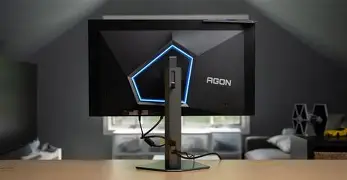
Real‑world use case: A streamer can route a gaming PC and a streaming PC into the monitor and switch inputs while retaining the same keyboard and mouse control. A remote worker can dock a laptop to the monitor and keep a second desktop powered on the same monitor for gaming in the evening — all without swapping peripherals.
4. Advanced OSD Utilities: Timers, Crosshairs, and Custom Picture Profiles
What it is: Beyond conventional picture presets, the Agon Pro exposes a suite of on‑screen display (OSD) utilities for competitive players and productivity users. These include customizable crosshairs, on‑screen timers, frame‑rate indicators, and the ability to store several user profiles with per‑input preferences.
Why it matters: Gamers often seek an edge that doesn’t rely on third‑party overlays. An integrated crosshair and timing tool give players a lightweight way to practice aim, measure input latency changes, or streamline training routines without additional software. For productivity, multiple stored profiles let users recall color, brightness, and picture‑by‑picture layouts instantly when switching tasks.
Real‑world use case: A competitive FPS player can test different frame pacing or sensitivity setups by switching OSD crosshair styles and adjusting low‑latency settings between practice rounds. A developer or designer can switch from a "coding" profile (cooler color temperature, reduced blue light) to a "calibration" profile (accurate color, neutral gamma) with a single button.
5. Flexible Multi‑Source Workflows: PIP, PBP, and Low‑Latency Input Switching
What it is: The monitor supports picture‑in‑picture (PIP) and picture‑by‑picture (PBP) layouts, plus optimized input switching designed to minimize the delay or re‑lock time when changing sources. This extends to preserved color settings per input so users don’t have to recalibrate when swapping devices.
Why it matters: Streamers, broadcasters, and multitaskers benefit when a single screen can display live content from one machine while hosting chat, monitoring encoders, or managing overlays from a second system. Low‑latency switching keeps gameplay responsive when changing inputs, and preserved per‑input profiles keep visual fidelity consistent.
Real‑world use case: A live event producer can monitor a feed from a capture machine in a PIP window while keeping a chat/production interface in the main area. A developer testing web layouts on different OSes can run two test rigs side‑by‑side for quick visual comparison without dual monitors.
Pros & Cons
- Pros
- High refresh and responsive performance suited for competitive gaming and smooth desktop use.
- Advanced HDR with local dimming improves perceived contrast and cinematic detail.
- Hardware calibration and internal LUT support deliver reliable color fidelity for creators.
- Integrated KVM and USB hub reduce cable clutter and streamline multi‑device workflows.
- Rich OSD utilities and PIP/PBP modes make it versatile for streamers and multitaskers.
- Cons
- Complex feature set requires time to learn and configure optimally.
- Local dimming can introduce haloing in certain scenes if not tuned perfectly.
- Hardware calibration tools and KVM utility may need separate software or firmware updates for best compatibility.
- Bulkier power and port requirements may complicate compact desk setups.
Comparison Table
| Feature | Agon Pro Ag276Qzd2 | Typical 27" High‑Refresh Competitor A | Typical 27" Creator‑oriented Competitor B |
|---|---|---|---|
| Panel Size | 27" (QHD) | 27" (QHD) | 27" (QHD/4K options) |
| Refresh Rate | High refresh (performance class) | High refresh (gaming focus) | Moderate to high (creator tradeoff) |
| HDR & Local Dimming | Local dimming zones / enhanced HDR | Basic HDR / fewer zones | Accurate HDR with professional tuning |
| Hardware Calibration | Internal LUT / hardware calibration support | Usually software calibration only | Hardware calibration common |
| Built‑in KVM / USB Hub | Yes — KVM + high‑speed USB ports | Occasional USB hub, rarely KVM | USB hub common, KVM less common |
| PIP / PBP | Flexible PIP/PBP with per‑input presets | Often limited PIP/PBP modes | Some models offer PIP/PBP |
Buying Guide: How to Decide if the Agon Pro Ag276Qzd2 Is Right for You
Choosing a monitor involves tradeoffs. The Agon Pro Ag276Qzd2 is compelling if the buyer values a single display that can do both high‑performance gaming and reliable color work. Use the checklist below to assess whether it fits specific needs.
Find top-rated Electronics products at great prices.
See Deals →1. Define the Primary Use
If the primary use is competitive FPS gaming, prioritize refresh rate, low input lag, and a responsive panel. If content creation and color accuracy are primary, prioritize hardware calibration, color gamut, and stable HDR rendering. The Agon Pro is designed to bridge both worlds, but buyers who exclusively need one side may find a more specialized model cheaper or simpler.
2. Evaluate HDR Performance and Local Dimming
Look for subjective HDR previews. Local dimming improves contrast but can cause blooming around bright objects. Buyers who watch a lot of HDR movies or grade HDR video should compare how well the monitor preserves shadow detail and how distracting haloing is in real scenes.
3. Confirm Calibration Workflow
Ask whether the monitor supports the calibration hardware and software already in use (X‑Rite, Datacolor, etc.). Verify whether calibration profiles can be stored on the display itself and recalled per input. This reduces surprises when switching between devices.
4. Consider Connectivity and Desktop Ergonomics
If the workstation includes multiple machines (laptop + desktop, or dual‑PC streaming setups), built‑in KVM and a fast USB hub become major conveniences. Ensure the monitor has the ports needed (DisplayPort for high refresh, HDMI for consoles, USB‑C if laptop docking is required) and a stand that supports height, tilt, and pivot adjustments for ergonomic comfort.
5. Test the OSD and Software Features
Time invested in learning OSD utilities pays off. Check if the OSD is intuitive and whether key features (crosshair overlay, timers, saved profiles) are accessible via hotkeys. Also, ask about firmware updates and vendor software that may add features or improve compatibility.
6. Check Warranty and Support
High‑end monitors often have longer warranties or pixel policies. Verify what the manufacturer covers, especially for the backlight and local dimming behavior. Prompt support and firmware update cadence are important if the user plans to rely on advanced features long‑term.
Practical Tips for Getting the Most from the Agon Pro Ag276Qzd2
- Run an initial hardware calibration: Even if the monitor is factory‑calibrated, a fresh hardware calibration tuned to the user’s ambient light yields the most accurate results for color work.
- Experiment with HDR presets: Test different HDR and local dimming presets across movies and games to find the best balance between highlight punch and minimal haloing.
- Use PIP/PBP for productivity: Set up a chat/stream monitor in PIP while gaming in the main window, or compare proofs side‑by‑side while editing.
- Leverage KVM for dual‑PC setups: Map keyboard shortcuts and hotkeys to simplify switching and avoid repetitive context changes when moving between machines.
- Keep firmware and drivers current: Monitor behavior (especially adaptive sync and KVM compatibility) can improve significantly after firmware updates; check the vendor’s support site periodically.
Conclusion
The Agon Pro Ag276Qzd2 is more than a high‑refresh QHD monitor; it’s a multi‑purpose tool that blends gaming performance with professional features. The five hidden elements highlighted here — refined HDR/local dimming, internal hardware calibration, integrated KVM and USB hub, advanced OSD utilities, and flexible multi‑source workflows — are the areas where it provides real differentiation. For buyers who juggle competitive gaming, streaming, and color‑sensitive creation on a single screen, those features reduce friction and make the monitor a central productivity and entertainment hub.
Ultimately, the right choice depends on priorities. Those who need a no‑frills gaming panel might prefer a simpler model with lower cost and fewer bells and whistles. Users who want one screen to handle both precise color work and high‑speed gaming will find the Agon Pro Ag276Qzd2’s hidden capabilities worth the investment — provided they are willing to spend time configuring profiles and firmware for their exact workflow.